Mathematical modeling & multiphysics
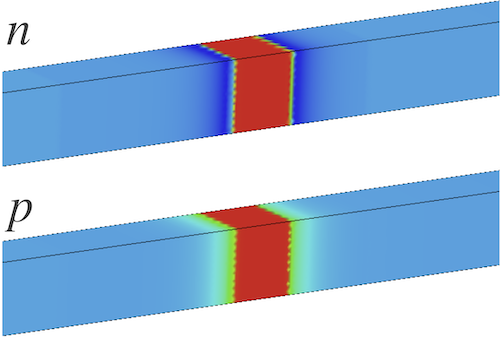
- Coupled phenomena: Charge transport, continuum mechanics, optics
- Multiscale bridging: Continuum-to-atomistic coupling
- Analytical theory of nonlinear drift-diffusion systems
Patricio Farrell's research lies at the interface of mathematical modeling, numerical analysis and scientific computing for complex physical systems. He develops mathematical models and theory for coupled nonlinear PDEs and designs structure-preserving numerical methods that capture key physical features.
A major focus lies on semiconductor charge transport. Here, coupled multiphysics and multiscale phenomena lead to complex nonlinear PDE systems. Numerical solution techniques are then implemented in open-source software and validated against experiments. This creates a feedback loop where application-driven challenges continuously motivate new mathematical questions, models and numerical methods.
The NUMSEMIC team investigates the following applications from applied mathematics, computational physics, materials science and electronic engineering.
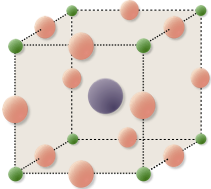
Low-cost perovskites showed early promise for turning sunlight into electricity. With their efficiency rising sharply, they offer a viable path to augment (via tandem cells) or replace traditional silicon panels. The main hurdle lies in internal ion movement, which impacts cell stability and is computationally difficult to simulate due to stiffness.
Cooperations: Helmholtz Zentrum Berlin, University of Oxford, Inria Lille/University of Lille, Zuse Institut Berlin
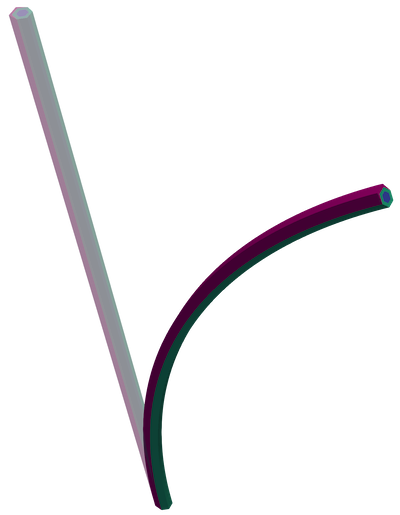
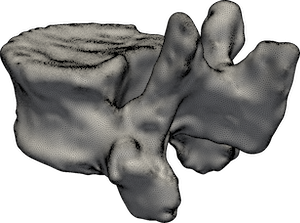
Nanowires have many potential applications, for example they may be used to build even smaller MOS transistors. Useful electronic properties of these thin wires can be controlled via elastic strain. However, unexpectedly slow charge carrier transport require careful simulations combining charge transport with continuum mechanics to explain the cause.
Cooperations: Paul-Drude-Institut (PDI), Leibniz Institute for High Performance Microelectronics (IHP)
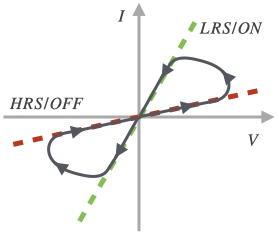
The von Neumann architecture is far from ideal for AI applications due to its unacceptably high energy consumption. Memristors help to emulate the energy efficiency of human brains. The group develops complex charge transport models which incorporate mobile point defects and Schottky barrier lowering to theoretically understand the shape and asymmetries of the hysteresis curves observed in experiments.
Cooperations: University of Kiel, TU Ilmenau
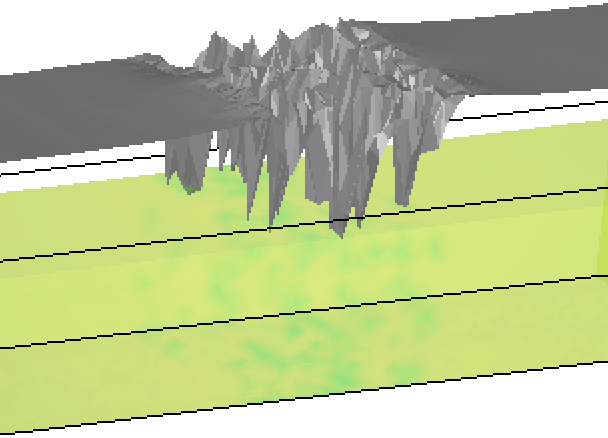
The primary objective is to simulate random alloy fluctuations in band edge profiles within full semiconductor devices. The approach combines atomic-level random band edge variations with macroscale drift-diffusion models. These spatially random band edges are implemented directly in ddfermi, while localization landscape theory (LLT) accounts for quantum confinement effects.
Cooperations: Tyndall National Institute (Cork, Ireland)
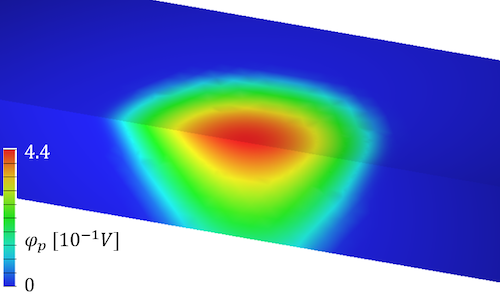
Several semiconductor-based imaging techniques help to predict fluctuations in doping profiles such as the laser beam induced current (LBIC) or the lateral photovoltage scanning (LPS) method. Mathematically, this translates into an inverse problem which is solved via data-driven techniques.
Cooperations: Institut für Kristallzüchtung, University of Florence, SISSA (Trieste, Italy)
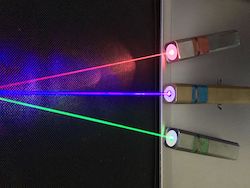
Semiconductor-based LiDAR sensors advance autonomous driving by offering high precision in a compact, scalable format for the mass market. Beyond automotive sensing, high-precision lasers are essential for quantum computing and metrology. The group models these devices by extending the van Roosbroeck framework to account for heterostructures, heat transport, and light emission through a coupled charge transport/Helmholtz formulation.
Cooperations: Ferdinand-Braun-Institut (FBH), University of Florence, University of Calabria
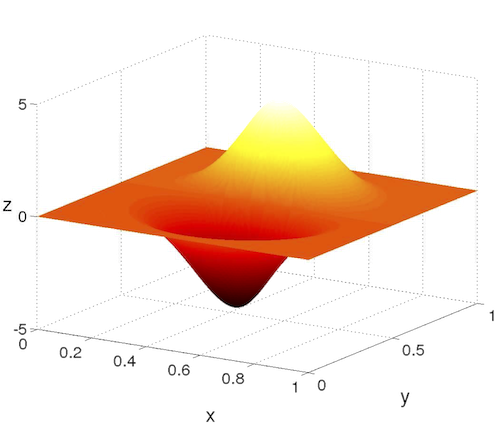
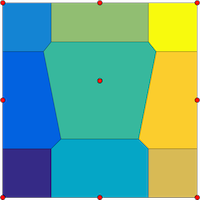
The core of machine learning algorithms consists of a (usually high-dimensional) optimization problem. To find a minimizer within such complex structures it is often beneficial to resort to surrogate models, which are minimized instead of the original problem. Due to the curse of dimensionality it is often not feasible to build meshes. For this reason meshfree methods help to efficiently build surrogate models.
Cooperations: University of Florence, SISSA, University of Kiel